
Watch Complications Glossary: Tourbillon to Grande Sonnerie
In watchmaking, a complication is anything a watch does beyond telling hours, minutes and seconds. The most prestigious watches combine many of them, which is where words like grand complication and supercomplication come from.
This glossary explains the terms used across our watch pages, with an example of where you can see each one.
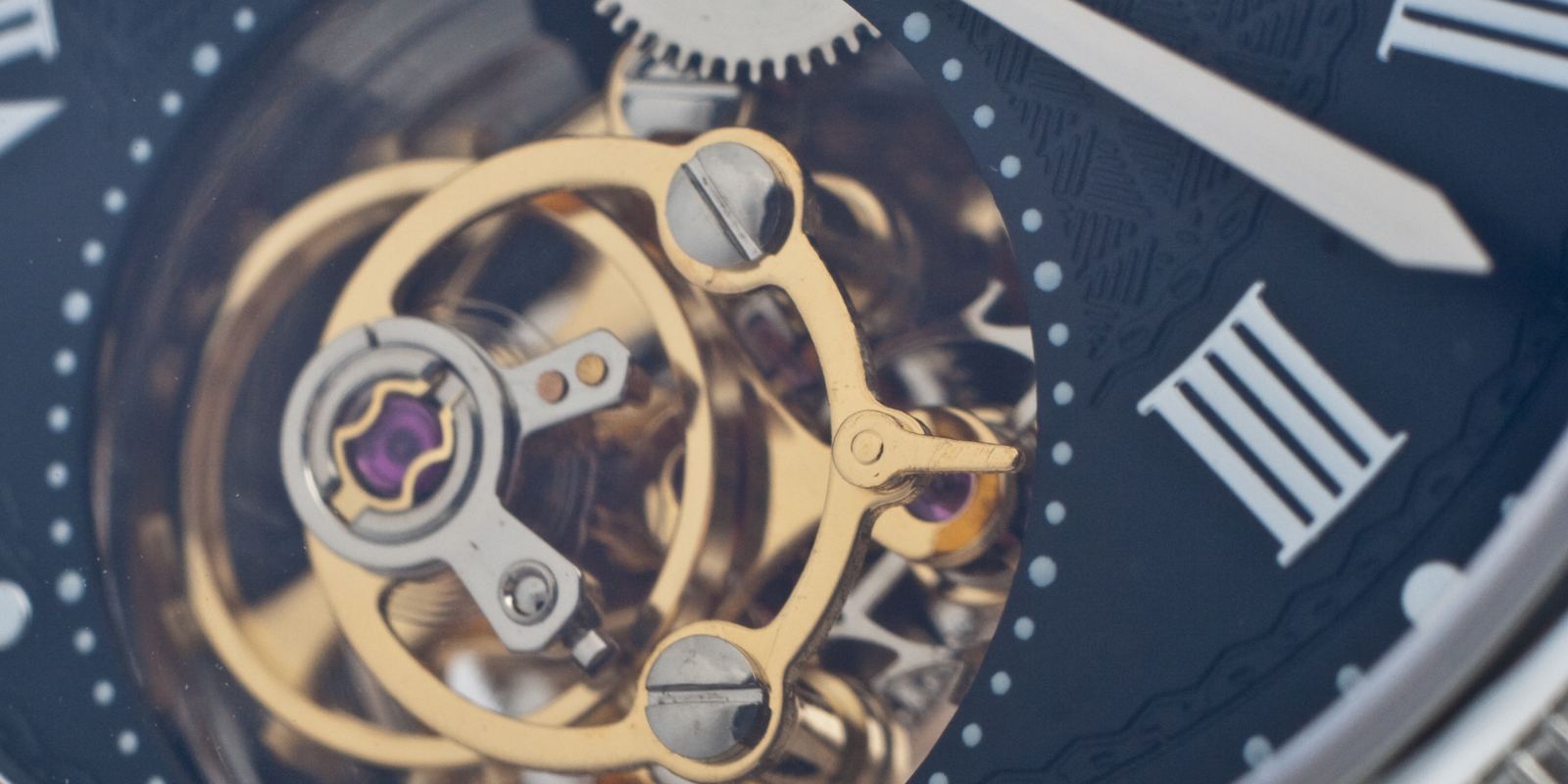
A tourbillon cage close up: Guy Sie from Utrecht, Netherlands, CC BY-SA 2.0
Glossary
| Term | What it means | Where to see it |
|---|---|---|
| Complication | Any function beyond hours, minutes and seconds | Every complicated watch |
| Tourbillon | Rotating cage for the balance and escapement that averages out gravity errors | Breguet, 1801; many haute horlogerie houses |
| Flying tourbillon | A tourbillon supported from one side only, so it seems to float | First designed by Alfred Helwig, 1920 |
| Minute repeater | Chimes the time on demand: hours, quarters, then minutes | Grandmaster Chime, Henry Graves Supercomplication |
| Grande sonnerie | Strikes hours and quarters automatically as time passes | Grandmaster Chime |
| Petite sonnerie | Strikes the hours automatically, quarters more simply | Grand striking watches |
| Perpetual calendar | Shows date, day and month and allows for leap years with no correction until 2100 | Patek Philippe grand complications |
| Chronograph | A built-in stopwatch started and stopped by pushers | Rolex Daytona |
| Split-seconds (rattrapante) | A chronograph with two seconds hands to time two events at once | Henry Graves Supercomplication |
| Tachymeter | Scale for working out average speed over a set distance | Rolex Daytona bezel |
| Moon phase | Shows the shape of the moon through its monthly cycle | Many dress and calendar watches |
| Equation of time | Difference between clock time and solar time through the year | Patek Philippe Calibre 89 |
| Celestial chart | Rotating map of the night sky for a given place | Henry Graves Supercomplication (New York sky) |
| Power reserve indicator | Shows how much energy is left in the mainspring | Many hand-wound and automatic watches |
| Self-winding rotor | A swinging weight that winds the mainspring as the wrist moves | Rolex Perpetual rotor, 1931 |
| Balance wheel | The oscillating wheel that divides time into equal beats | All mechanical watches |
| Escapement | Releases the gear train one step per beat of the balance | All mechanical watches |
| Chronometer | A watch tested and certified for high accuracy | Rolex, many Swiss makers |
Quick questions
What is a grand complication?
A watch that combines several major complications, usually including a chiming function, a perpetual calendar and a chronograph. Makers use the term in slightly different ways.
Does a tourbillon make a wristwatch more accurate?
It was designed for pocket watches that stayed in one position for hours. In a wristwatch that moves constantly the benefit is smaller, so today it is valued mainly as a display of skill.
Why are chiming watches so rare?
Repeaters and sonneries need tiny hammers, gongs and many coordinating parts, and each watch must be tuned by ear. Few watchmakers specialise in them.
What is the most complicated watch ever made?
The title has moved over time. The Henry Graves Supercomplication held it for over 50 years with 24 complications, then Patek Philippe's Calibre 89 of 1989 had 33. Newer pieces from several makers have since claimed even more.
What is the difference between automatic and manual winding?
A manual watch is wound by turning the crown. An automatic, or self-winding, watch has a rotor that winds the mainspring as you move, a system Rolex made practical in 1931.
The Greatest Prestige collection
Tees and hoodies in the Greatest Prestige colors, printed to order in the USA. Use code VIP15 from the newsletter for 15% off your first order.





- Wikipedia: Tourbillon
- Wikipedia: Patek Philippe
- Wikipedia: Patek Philippe Henry Graves Supercomplication
- Wikipedia: Rolex
- Wikipedia: Rolex Daytona
Facts on this page were checked against these sources (updated Oct 13, 2026). Spot an error? Email hello@fireempireshop.com.